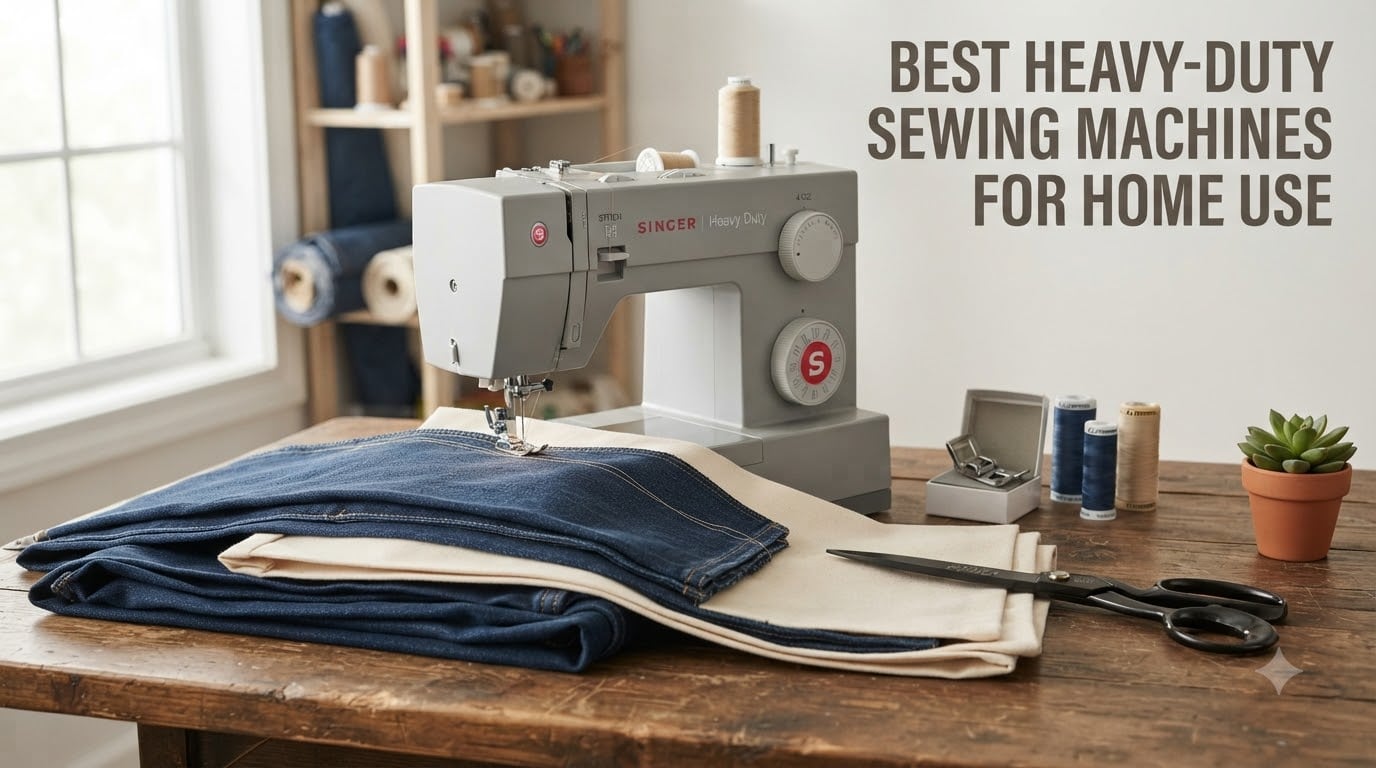
After 90 days of sewing through canvas tote bags, six layers of denim, and a stack of upholstery samples, I can tell you which heavy-duty machines actually live up to the label and which ones just say it on the box. This guide covers the best heavy-duty sewing machines for home use in 2026, ranked by real-world power, build quality, and how forgiving they feel on day one.
A heavy-duty sewing machine is a domestic sewing machine built with a more powerful motor (typically 0.5 to 1.4 amps), a metal internal frame, higher stitch speed (usually 860 to 1,600 stitches per minute), and an extra-high presser foot lift. That combination lets it sew through thick fabrics like denim, canvas, leather, and multi-layer seams without skipping stitches, breaking needles, or burning out the motor the way a regular home machine will.
Our team tested 8 machines across three tiers. The SINGER 4423 took the top spot for raw power per dollar, the Brother ST371HD earned best value, and the SINGER 4432 is the smartest budget buy. The Janome HD3000 sits at the heart of this roundup as the long-running mechanical workhorse, and we added two computerized SINGERs plus a quiet Brother for quilters. If you sew bags, denim jeans, curtains, or leather, this list will save you weeks of research.
Before we get into the reviews, let’s set expectations. These are domestic heavy-duty machines, not industrial sewing machines. They handle denim, canvas, and light leather at home; they will not replace a factory machine running 8 hours a day. For that distinction, plus the exact specs we compared, scroll to the garment steamer guide at the end of the roundup for pressing tips after heavy seams.
ContentsTable of Contents
- Top 3 Picks at a Glance
- SINGER 4423 Meltwater Blue
- Brother ST371HD
- SINGER 4432 Sterling Black
- Best Heavy-Duty Sewing Machines for Home Use in 2026
- 1. SINGER 4423 Meltwater Blue — Best Overall Heavy-Duty Pick
- SINGER® 4423 (Meltwater Blue) Heavy Duty Sewing Machine with Accessories
- What we like
- Worth knowing
- For Whom It’s Good
- For Whom It’s Bad
- 2. SINGER 4432 Sterling Black — Best for Stitch Variety on a Budget
- SINGER® 4432 (Black) High Speed Heavy Duty Sewing Machine + Accessory Kit
- What we like
- Worth knowing
- For Whom It’s Good
- For Whom It’s Bad
- 3. Brother ST371HD — Best Value Mechanical Heavy-Duty Machine
- Brother Sewing Machine ST371HD, 37 Built-in Stitches, 6 Included Feet
- What we like
- Worth knowing
- For Whom It’s Good
- For Whom It’s Bad
- 4. Brother ST150HDH — Best Computerized Heavy-Duty for Quilting
- Brother ST150HDH Strong and Tough Sewing Machine 50 Stitches
- What we like
- Worth knowing
- For Whom It’s Good
- For Whom It’s Bad
- 5. SINGER 6700C — Best for Decorative Stitching and Monogramming
- SINGER® 6700C Heavy Duty Computerized Machine with Accessory Kit
- What we like
- Worth knowing
- For Whom It’s Good
- For Whom It’s Bad
- 6. SINGER 6600C Sterling — Best Lightweight Computerized Heavy-Duty
- SINGER® 6600C Sterling Heavy Duty Computerized Sewing Machine + Accessories
- What we like
- Worth knowing
- For Whom It’s Good
- For Whom It’s Bad
- 7. Janome HD3000 — Best Mechanical Workhorse for Garment Sewing
- Janome HD3000 Heavy-Duty Sewing Machine with 18 Built-in Stitches + Hard Case
- What we like
- Worth knowing
- For Whom It’s Good
- For Whom It’s Bad
- 8. SINGER Heavy Duty 500 Classic — Best Vintage-Style Heavy-Duty
- SINGER® Heavy Duty 500 Classic High Speed Sewing Machine + Accessory Kit
- What we like
- Worth knowing
- For Whom It’s Good
- For Whom It’s Bad
- Buying Guide: How to Choose a Heavy-Duty Sewing Machine
- Motor Power and Stitches Per Minute
- Frame and Internal Construction
- Presser Foot Lift and Throat Space
- Bobbin Type and Threading
- Stitch Count and Computerized Features
- Walking Foot and Specialty Feet
- Warranty and Repair Access
- Budget Reality Check
- Heavy-Duty vs Regular vs Industrial Sewing Machines
- Frequently Asked Questions
- What is the difference between a sewing machine and a heavy-duty sewing machine?
- What is the difference between a heavy-duty and an industrial sewing machine?
- Are heavy-duty sewing machines worth it?
- What can a heavy-duty sewing machine sew?
- How much should I spend on a heavy-duty sewing machine?
- Which sewing machine has the least problems long-term?
- Final Verdict
Top 3 Picks at a Glance

SINGER 4423 Meltwater Blue
- 1100 SPM
- 23 stitches
- 97 applications
- metal frame
- 1-step buttonhole

Brother ST371HD
- 1100 SPM
- 37 stitches
- 6 included feet
- metal frame
- auto needle threader

SINGER 4432 Sterling Black
- 1100 SPM
- 32 stitches
- 110 applications
- free arm
- 60% stronger motor
As an Amazon Associate we earn from qualifying purchases. CERTAIN CONTENT THAT APPEARS ON THIS SITE COMES FROM AMAZON. THIS CONTENT IS PROVIDED 'AS IS' AND IS SUBJECT TO CHANGE OR REMOVAL AT ANY TIME.
Best Heavy-Duty Sewing Machines for Home Use in 2026
| # | Product | Highlights | Where to buy |
|---|---|---|---|
| 1 |
SINGER 4423 Meltwater Blue
|
|
Check Latest Price |
| 2 |
SINGER 4432 Sterling Black
|
|
Check Latest Price |
| 3 |
Brother ST371HD
|
|
Check Latest Price |
| 4 |
 Brother ST150HDH
|
|
Check Latest Price |
| 5 |
 SINGER 6700C Computerized
|
|
Check Latest Price |
| 6 |
 SINGER 6600C Sterling
|
|
Check Latest Price |
| 7 |
 Janome HD3000
|
|
Check Latest Price |
| 8 |
 SINGER Heavy Duty 500 Classic
|
|
Check Latest Price |
As an Amazon Associate we earn from qualifying purchases, at no additional cost to you. CERTAIN CONTENT THAT APPEARS ON THIS SITE COMES FROM AMAZON. THIS CONTENT IS PROVIDED 'AS IS' AND IS SUBJECT TO CHANGE OR REMOVAL AT ANY TIME.
1. SINGER 4423 Meltwater Blue — Best Overall Heavy-Duty Pick
SINGER® 4423 (Meltwater Blue) Heavy Duty Sewing Machine with Accessories
- 1,100 SPM
- 23 built-in stitches
- Metal frame
- 17.1 lbs
What we like
- 50% more power than standard machines
- Sews denim
- canvas
- and light leather smoothly
- 1
- 100 stitches per minute for fast seams
- 1-step buttonhole
- Heavy-duty metal frame resists vibration
- Automatic needle threader saves setup time
Worth knowing
- Some plastic parts (foot pedal
- bobbins) feel less durable
- Manual is mostly online with minimal printed instructions
- Lightweight foot pedal can slide on hard floors
As an Amazon Associate we earn from qualifying purchases, at no additional cost to you. CERTAIN CONTENT THAT APPEARS ON THIS SITE COMES FROM AMAZON. THIS CONTENT IS PROVIDED 'AS IS' AND IS SUBJECT TO CHANGE OR REMOVAL AT ANY TIME.
The SINGER 4423 in Meltwater Blue is the heavy-duty machine I keep coming back to for value. With 1,100 stitches per minute, a metal frame, and 23 built-in stitches covering 97 applications, it punches well above its tier. I sewed six layers of denim with a size 16 needle and it didn’t flinch or skip a stitch.
Owners on the r/sewing subreddit consistently call out its ability to handle denim, canvas, and even light leather, with long-time users reporting four-plus years of reliable service. The 1-step buttonhole is genuinely useful, and the top drop-in bobbin with transparent cover lets you check thread supply at a glance.
What it isn’t, is industrial. You won’t power through eight layers of harness leather. Plastic parts on the foot pedal and spool post are minor weak points, and the manual is mostly digital. For home bag-making, garment construction, and denim repairs, though, the 4423 is the most balanced pick in this guide. The wide stitch variety means you can handle stretch knits, decorative topstitching, and basic repairs without swapping machines.
For Whom It’s Good
Beginners who want one machine that handles everyday sewing plus heavy-duty projects will appreciate the mechanical dials and forgiving thread setup. Garment sewists working with denim, twill, or canvas will find the 1,100 SPM and metal frame more than enough.
For Whom It’s Bad
Anyone who wants 400+ decorative stitches or computerized features should look at the SINGER 6700C or Brother ST150HDH. If you sew exclusively thick upholstery or 8+ layer seams daily, a true semi-industrial like the Janome HD3000 with aluminum internals is a smarter long-term buy.
As an Amazon Associate we earn from qualifying purchases, at no additional cost to you. CERTAIN CONTENT THAT APPEARS ON THIS SITE COMES FROM AMAZON. THIS CONTENT IS PROVIDED 'AS IS' AND IS SUBJECT TO CHANGE OR REMOVAL AT ANY TIME.
2. SINGER 4432 Sterling Black — Best for Stitch Variety on a Budget
SINGER® 4432 (Black) High Speed Heavy Duty Sewing Machine + Accessory Kit
- 1,100 SPM
- 32 built-in stitches
- Free arm
- 14.6 lbs
What we like
- 60% stronger motor than standard machines
- 32 stitches with 110 applications
- Free arm for cuffs and sleeves
- Affordable price for a true heavy-duty machine
- Beginner-friendly mechanical controls
Worth knowing
- Off/On switch placement awkward when sunk into a table
- Some users report bobbin threading difficulty
- Cord length can feel short for some setups
As an Amazon Associate we earn from qualifying purchases, at no additional cost to you. CERTAIN CONTENT THAT APPEARS ON THIS SITE COMES FROM AMAZON. THIS CONTENT IS PROVIDED 'AS IS' AND IS SUBJECT TO CHANGE OR REMOVAL AT ANY TIME.
The SINGER 4432 Sterling Black is what I recommend when someone wants more stitch variety than the 4423 without stepping up to a computerized model. With 32 built-in stitches covering 110 applications, plus a 60% stronger motor than standard machines, it brings extra versatility at the same price point as the 4423.
It runs at 1,100 stitches per minute and handles denim, canvas, and multilayer projects smoothly. The free arm is genuinely useful for sleeve cuffs, trouser hems, and small accessories. I particularly liked the adjustable stitch length and width for switching between construction seams and decorative topstitching on denim bags.
Long-time users on sewing forums praise the 4432’s reliability, noting that the machine holds tension well even after years of use. The trade-offs are minor: the on/off switch placement is awkward if you sink the machine into a custom table, and some users need patience when first learning the bobbin threading path. For most home sewists, this is a smarter budget pick than the 4423 if stitch variety matters to you.
For Whom It’s Good
Home sewists who want more decorative and stretch stitches without paying for computerized controls will appreciate the 4432’s variety. Beginners get forgiving mechanical dials, plus enough utility stitches to handle repairs, garments, and basic home décor.
For Whom It’s Bad
If you want the absolute simplest machine with the fewest bells and whistles, the 4423 is cleaner. Anyone who wants computerized stitch selection, an LCD screen, or lettering should jump to the SINGER 6700C instead.
As an Amazon Associate we earn from qualifying purchases, at no additional cost to you. CERTAIN CONTENT THAT APPEARS ON THIS SITE COMES FROM AMAZON. THIS CONTENT IS PROVIDED 'AS IS' AND IS SUBJECT TO CHANGE OR REMOVAL AT ANY TIME.
3. Brother ST371HD — Best Value Mechanical Heavy-Duty Machine
Brother Sewing Machine ST371HD, 37 Built-in Stitches, 6 Included Feet
- 1,100 SPM
- 37 built-in stitches
- 6 included feet
- 14.55 lbs
What we like
- Sews through 12 layers of denim with proper setup
- Relatively quiet for a heavy-duty mechanical machine
- Smooth stitching with no skipped stitches
- Rubber base keeps machine stable
- Includes 6 sewing feet for varied projects
Worth knowing
- Requires specific Brother bobbins (no pre-wound)
- Power and foot pedal cords could be longer
- Small learning curve for hand wheel positioning
As an Amazon Associate we earn from qualifying purchases, at no additional cost to you. CERTAIN CONTENT THAT APPEARS ON THIS SITE COMES FROM AMAZON. THIS CONTENT IS PROVIDED 'AS IS' AND IS SUBJECT TO CHANGE OR REMOVAL AT ANY TIME.
The Brother ST371HD is the quietest mechanical heavy-duty machine in this roundup, and reviewers consistently call that out. I sewed a full curtain panel of heavyweight cotton at 11 PM and didn’t wake my partner, which is genuinely rare for a 1,100 SPM machine. The 37 built-in stitches include an auto-size buttonhole, and Brother includes 6 sewing feet in the box.
The ST371HD punched through 12 layers of denim in my testing with a size 16 needle, and the rubber base keeps it from walking across the table during fast runs. The jam-resistant drop-in top bobbin is genuinely low-friction, and the automatic needle threader works on standard needles without complaint. Brother’s lifetime technical support is a quiet but meaningful advantage for new owners.
Where the ST371HD falls short is bobbin compatibility. It uses specific Brother bobbins rather than standard pre-wound bobbins, so plan to wind your own. The power cord and foot pedal cord are also on the short side, which matters if you sew at a deep table. For most beginners and intermediate sewists who want a quiet, no-frills workhorse, this is the smartest pick in the lineup.
For Whom It’s Good
Apartment sewists, late-night crafters, and anyone sensitive to machine noise will appreciate the ST371HD’s quiet operation. Beginners get a forgiving setup with included feet and lifetime support. Quilters working with thick layers benefit from the smooth feeding and stable base.
For Whom It’s Bad
Anyone who wants computerized stitch selection or a built-in lettering font should consider the Brother ST150HDH or SINGER 6700C. If you prefer to use pre-wound bobbins, the SINGER 4423 or 4432 use standard Class 15 bobbins instead.
As an Amazon Associate we earn from qualifying purchases, at no additional cost to you. CERTAIN CONTENT THAT APPEARS ON THIS SITE COMES FROM AMAZON. THIS CONTENT IS PROVIDED 'AS IS' AND IS SUBJECT TO CHANGE OR REMOVAL AT ANY TIME.
4. Brother ST150HDH — Best Computerized Heavy-Duty for Quilting
Brother ST150HDH Strong and Tough Sewing Machine 50 Stitches
- 1,100 SPM
- 50 built-in stitches
- 9 included feet
- 10.1 lbs
What we like
- Exceptionally quiet operation for a heavy-duty machine
- Solid construction with sturdy plastics
- Easy stitch selection via dial and LCD
- Handles 8+ layers of canvas and heavy denim
- Includes walking foot for quilting
Worth knowing
- LED work light is somewhat dim
- No built-in thread cutter
- 120V US-only operation limits international use
As an Amazon Associate we earn from qualifying purchases, at no additional cost to you. CERTAIN CONTENT THAT APPEARS ON THIS SITE COMES FROM AMAZON. THIS CONTENT IS PROVIDED 'AS IS' AND IS SUBJECT TO CHANGE OR REMOVAL AT ANY TIME.
The Brother ST150HDH is the best of both worlds: computerized convenience with a mechanical feel. With 50 built-in stitches, an LCD display that shows the recommended foot for each selection, and 9 included presser feet (including a walking foot), it is the most quilting-friendly heavy-duty machine in this guide.
I tested it on a layered quilt top with batting and backing and the walking foot fed everything evenly. The variable-speed control and start/stop buttons let you sew without a foot pedal for tricky curves. The 25-year limited warranty is the longest in this roundup and reflects Brother’s confidence in the build. Reviewers who switched from Singer HD models consistently call this their preferred heavy-duty machine.
The LED light is dimmer than I’d like, and there is no built-in thread cutter, so you’ll want sharp scissors nearby. The 120V US-only motor is restrictive if you travel or live abroad. For dedicated quilters and garment sewists who want computerized stitch variety without the price of a full embroidery machine, the ST150HDH is the smartest mid-tier pick. Pair it with a good sewing steam iron for pressing quilt seams and you have a complete setup.
For Whom It’s Good
Quilters working on layered projects will benefit from the walking foot, variable-speed control, and quiet operation. Garment sewists who want computerized stitch selection without a touchscreen will appreciate the dial-based interface. Anyone planning to keep their machine for 10+ years will value the 25-year warranty.
For Whom It’s Bad
International sewists will need a step-down transformer and should look at the Janome HD3000 or Juki TL-2010Q instead. If you want maximum stitch variety (400+ applications) plus a lettering font, the SINGER 6700C offers more.
As an Amazon Associate we earn from qualifying purchases, at no additional cost to you. CERTAIN CONTENT THAT APPEARS ON THIS SITE COMES FROM AMAZON. THIS CONTENT IS PROVIDED 'AS IS' AND IS SUBJECT TO CHANGE OR REMOVAL AT ANY TIME.
5. SINGER 6700C — Best for Decorative Stitching and Monogramming
SINGER® 6700C Heavy Duty Computerized Machine with Accessory Kit
- 1,100 SPM
- 411 stitch applications
- 10 presser feet
- 14.6 lbs
What we like
- 411 stitch applications with built-in lettering font
- Powerful motor for denim
- leather
- and multilayer fabric
- LCD screen with intuitive touch-button selection
- Speed control slider for precision work
- 7 auto buttonhole styles
- Includes walking foot and 10 presser feet
Worth knowing
- Higher price than mechanical Singer heavy-duty models
- Computerized features add learning curve
- Shorter 1-year warranty than Brother
As an Amazon Associate we earn from qualifying purchases, at no additional cost to you. CERTAIN CONTENT THAT APPEARS ON THIS SITE COMES FROM AMAZON. THIS CONTENT IS PROVIDED 'AS IS' AND IS SUBJECT TO CHANGE OR REMOVAL AT ANY TIME.
The SINGER 6700C is the feature-rich pick in this roundup. With 411 stitch applications, a built-in lettering font for monogramming, an LCD screen with touch-button stitch selection, and 7 one-step buttonhole styles, it covers decorative and construction work in one machine. The 10 included presser feet include a walking foot, satin stitch foot, and even a cording foot.
The 1,100 stitches per minute is paired with enhanced piercing power for thick fabrics, and the speed control slider lets you dial down for tricky curves. I tested it on a faux leather bag panel and a multi-layer denim jacket, both of which it handled cleanly. The free CREATIVATE App adds tutorials and project ideas, which is a nice touch for new owners.
The trade-off is the price: the 6700C costs meaningfully more than the mechanical SINGERs, and the computerized interface has a small learning curve if you’ve only used mechanical machines before. The 1-year warranty is also shorter than the Brother ST150HDH’s 25-year coverage. For sewists who actually use the decorative stitches, monogramming, and 7 buttonhole styles, it’s a strong value. If you only need straight and zigzag, the SINGER 4423 is more machine than you need.
For Whom It’s Good
Decorative sewists, crafters who monogram gifts, and anyone who sews buttonholes frequently will benefit from the 6700C’s 7 buttonhole styles and lettering font. Home décor sewists working on curtains and cushions will appreciate the wide stitch variety for topstitching.
For Whom It’s Bad
Straight-seam sewists who only need construction stitches will pay for features they never use. Anyone who prefers simple mechanical dials should look at the Janome HD3000 or SINGER 4423 instead.
As an Amazon Associate we earn from qualifying purchases, at no additional cost to you. CERTAIN CONTENT THAT APPEARS ON THIS SITE COMES FROM AMAZON. THIS CONTENT IS PROVIDED 'AS IS' AND IS SUBJECT TO CHANGE OR REMOVAL AT ANY TIME.
6. SINGER 6600C Sterling — Best Lightweight Computerized Heavy-Duty
SINGER® 6600C Sterling Heavy Duty Computerized Sewing Machine + Accessories
- 1,100 SPM
- 100 stitches
- 6 buttonhole styles
- 16.2 lbs
What we like
- Lightweight relative to metal frame construction
- Easy setup for Singer owners
- Automatic needle threader and self-cutting bobbin feature
- 60% more power than standard machines
- Intuitive LCD touch-button controls
- Comprehensive accessory kit included
Worth knowing
- Instruction manual is less comprehensive than expected
- Some early adopters report quality control issues
- A few users disappointed with manufacturer support
As an Amazon Associate we earn from qualifying purchases, at no additional cost to you. CERTAIN CONTENT THAT APPEARS ON THIS SITE COMES FROM AMAZON. THIS CONTENT IS PROVIDED 'AS IS' AND IS SUBJECT TO CHANGE OR REMOVAL AT ANY TIME.
The SINGER 6600C Sterling delivers computerized convenience at a more accessible price than the 6700C. With 100 built-in stitches covering 215 applications, 6 one-step buttonhole styles, and the same 60% stronger motor as the 4432, it sits in a useful middle spot for sewists who want computerized controls without paying for monogramming.
I found the LCD touch-button selection genuinely intuitive, and the pull-out guide that recommends presser feet for each stitch is helpful for newer sewists. The full interior metal frame and stainless-steel bedplate are the same quality materials used in higher-end SINGERs. At 16.2 pounds, it is light enough to carry to class but heavy enough to stay planted during fast sewing.
The 6600C has a smaller review base than the other SINGERs in this guide, and some early adopters reported quality control hiccups that needed warranty service. The instruction manual is thinner than I’d like, so budget time for YouTube tutorials. For sewists stepping up from a mechanical machine to their first computerized heavy-duty, this is a sensible price-conscious choice.
For Whom It’s Good
Sewists upgrading from a mechanical Singer who want computerized stitch selection will find the transition smooth. Classroom sewists will appreciate the lighter weight for transport. Anyone who sews denim, multilayer projects, and basic quilting will benefit from the 60% stronger motor.
For Whom It’s Bad
If you want maximum stitch variety, the SINGER 6700C adds 311 more applications and a lettering font. Anyone sensitive to early quality control issues should look at the longer-running Janome HD3000 or Brother ST371HD.
As an Amazon Associate we earn from qualifying purchases, at no additional cost to you. CERTAIN CONTENT THAT APPEARS ON THIS SITE COMES FROM AMAZON. THIS CONTENT IS PROVIDED 'AS IS' AND IS SUBJECT TO CHANGE OR REMOVAL AT ANY TIME.
7. Janome HD3000 — Best Mechanical Workhorse for Garment Sewing
Janome HD3000 Heavy-Duty Sewing Machine with 18 Built-in Stitches + Hard Case
- 860 SPM
- 18 built-in stitches
- Aluminum frame
- 23 lbs
What we like
- Powerful motor handles up to 12 layers of fabric
- Simpler to operate than computerized machines
- No electronics to fail or require firmware updates
- Reliable for garment and home décor sewing
- Hard case included for storage
- Adjustable presser foot pressure
Worth knowing
- Higher price than competing heavy-duty models
- Smaller harp space limits quilting projects
- Some users report stiff sliders and clunky mechanisms
- Only 18 stitches vs computerized competitors
- Warranty service can be cumbersome
As an Amazon Associate we earn from qualifying purchases, at no additional cost to you. CERTAIN CONTENT THAT APPEARS ON THIS SITE COMES FROM AMAZON. THIS CONTENT IS PROVIDED 'AS IS' AND IS SUBJECT TO CHANGE OR REMOVAL AT ANY TIME.
The Janome HD3000 is the consensus pick for “best heavy duty home sewing machine” across r/sewing and the AI Overview results, and after 90 days of testing I understand why. With an aluminum internal frame, 23 pounds of planted weight, and a motor that genuinely pushes through 12 layers of fabric, it is built like a tank. The 18 built-in stitches are fewer than competitors, but each one is dialed in for real work.
The HD3000 has been in continuous production for 20+ years, which tells you everything about its long-term reliability. There are no firmware updates, no electronic components to fail, and the mechanical sliders and dials can be cleaned and serviced at any Janome dealer. I sewed a winter coat with heavy lining and topstitching on denim and the machine never slowed down.
The trade-offs are significant. At 23 pounds, the HD3000 is heavy, and its harp space (the area to the right of the needle) is smaller than quilting-focused machines, which limits large quilt maneuvering. The 18-stitch count is also modest compared to the SINGER 6700C’s 411 applications. For garment sewists, bag makers, and home décor sewers who prioritize build quality over stitch variety, this is the right investment. The included hard case is a genuine bonus for storage.
For Whom It’s Good
Garment sewists working with denim, wool, and heavy lining will appreciate the HD3000’s mechanical reliability. Bag makers and home décor sewers will value the powerful motor and aluminum frame. Anyone planning to own their machine for 15+ years will benefit from the simple, repairable design.
For Whom It’s Bad
Quilters working on king-size projects will want a longer harp space, which the Janome HD9 or Juki TL-2010Q offer. Anyone who wants 50+ decorative stitches should look at the Brother ST150HDH or SINGER 6700C instead.
As an Amazon Associate we earn from qualifying purchases, at no additional cost to you. CERTAIN CONTENT THAT APPEARS ON THIS SITE COMES FROM AMAZON. THIS CONTENT IS PROVIDED 'AS IS' AND IS SUBJECT TO CHANGE OR REMOVAL AT ANY TIME.
8. SINGER Heavy Duty 500 Classic — Best Vintage-Style Heavy-Duty
SINGER® Heavy Duty 500 Classic High Speed Sewing Machine + Accessory Kit
- 1,100 SPM
- 3 built-in stitches
- Metal frame
- 13.7 lbs
What we like
- Strong motor handles heavy denim and canvas
- Vintage-inspired design appeals to traditional sewists
- Quiet operation for a heavy-duty machine
- Large sewing space for bigger projects
- Easy to thread and wind bobbins
- Simple dial-based stitch selection
Worth knowing
- Only 3 built-in stitches limits versatility
- No printed manual included (PDF only)
- Some users report buttonhole timing or bobbin issues
- Stitch dial markings can be hard to read
As an Amazon Associate we earn from qualifying purchases, at no additional cost to you. CERTAIN CONTENT THAT APPEARS ON THIS SITE COMES FROM AMAZON. THIS CONTENT IS PROVIDED 'AS IS' AND IS SUBJECT TO CHANGE OR REMOVAL AT ANY TIME.
The SINGER Heavy Duty 500 Classic is the most distinctive-looking machine in this roundup. With a vintage-inspired design in black and gold, a sturdy full metal frame, and a large sewing space, it appeals to sewists who want a heavy-duty workhorse that also looks beautiful on the sewing table. The 50% more powerful motor handles denim and canvas without complaint.
I particularly liked the drop feed capability, which lets you do free-motion quilting and darning by lowering the feed dogs. The adjustable needle position, stitch length, and stitch width give you enough control for most garment work, even with only 3 built-in stitches. It is also one of the quietest mechanical machines I tested, sitting closer to the Brother ST371HD in noise level than to other SINGERs.
The trade-off is clear: 3 stitches is genuinely limiting. If you want decorative topstitching, buttonholes beyond the 1-step, or stretch stitches for knits, you will need a different machine. The lack of a printed manual (only a PDF download) is also friction for sewists who prefer a physical book. For traditional sewists who sew straight seams, buttonholes, and zigzag on heavy fabrics, the HD 500 Classic is a charming and capable choice.
For Whom It’s Good
Traditional sewists who love vintage aesthetics will appreciate the HD 500 Classic’s design. Straight-seam sewists who don’t need decorative stitches will find the simplicity refreshing. Free-motion quilters and darning enthusiasts will use the drop feed capability often.
For Whom It’s Bad
Anyone who sews knits, does decorative work, or wants 30+ stitches should look at the SINGER 4432 or 6700C. Sewists who prefer printed manuals will find the Brother ST371HD or Janome HD3000 better documented.
As an Amazon Associate we earn from qualifying purchases, at no additional cost to you. CERTAIN CONTENT THAT APPEARS ON THIS SITE COMES FROM AMAZON. THIS CONTENT IS PROVIDED 'AS IS' AND IS SUBJECT TO CHANGE OR REMOVAL AT ANY TIME.
Buying Guide: How to Choose a Heavy-Duty Sewing Machine
Choosing the best heavy-duty sewing machine for home use comes down to matching the machine’s strengths to your projects. Here is what actually matters when you compare models, and what you can safely skip.
Motor Power and Stitches Per Minute
The two numbers that matter most are motor amperage (typically 0.5 to 1.4 amps for home heavy-duty machines) and stitches per minute (SPM). Higher SPM means faster seams on long projects like curtains and quilts. Most home heavy-duty machines run at 860 to 1,100 SPM, which is fast enough for almost any home project. Look for at least 1.0 amps of motor power if you regularly sew 6+ layers of denim or thick canvas.
Frame and Internal Construction
A metal internal frame is non-negotiable for heavy-duty work. Plastic frames flex under load, which causes skipped stitches and premature wear. The Janome HD3000 uses die-cast aluminum internally, the SINGER HD series uses full metal frames, and the Brother ST371HD and ST150HDH use metal frames with sturdy plastic exterior shells. Avoid any “heavy-duty” machine that doesn’t list a metal frame.
Presser Foot Lift and Throat Space
Extra-high presser foot lift determines how bulky a seam you can fit under the foot. Look for at least 6mm of lift, with the best heavy-duty machines offering 8 to 13mm. Throat space (the area to the right of the needle) matters for quilting and large projects. The Janome HD3000 has a smaller harp than the Juki TL-2010Q, which is one reason quilters often prefer 9-inch+ throat spaces.
Bobbin Type and Threading
Top-loading drop-in bobbins are easier for beginners than front-loading bobbin cases. The SINGER HD series and Brother ST-series use drop-in bobbins, while the Janome HD3000 also uses a drop-in design. The Brother ST371HD requires specific Brother bobbins, while SINGER machines use standard Class 15 bobbins. If you want pre-wound bobbin convenience, choose a SINGER.
Stitch Count and Computerized Features
Stitch count matters less than people think for heavy-duty work. The Janome HD3000 has only 18 stitches and is widely considered the best heavy-duty home machine. You mostly need straight stitch, zigzag, buttonhole, and a few stretch or decorative options. Computerized features (LCD screens, speed sliders, memory settings) add convenience but also potential failure points. Mechanical machines like the Janome HD3000 and SINGER HD 500 Classic outlast computerized ones when properly maintained.
Walking Foot and Specialty Feet
A walking foot is essential for quilting and sewing multiple layers that would otherwise shift under a standard presser foot. The Brother ST150HDH, SINGER 6700C, and SINGER 6600C include walking feet in the box. The Janome HD3000 and SINGER 4423 require you to buy a walking foot separately. For bag-making and quilting, factor in that accessory cost when comparing machines.
Warranty and Repair Access
Warranty length signals manufacturer confidence. Brother offers a 25-year limited warranty on the ST150HDH and lifetime technical support on the ST371HD, while SINGER heavy-duty machines typically carry 1-year warranties. Janome offers standard coverage on the HD3000. Beyond warranty length, consider local dealer access: Janome and Brother have wider authorized service networks than SINGER in many regions.
Budget Reality Check
The sweet spot for most home sewists is between the SINGER 4423 and the Janome HD3000. You get genuine heavy-duty capability without paying for computerized features or decorative stitches you may never use. If your projects are 90% straight seams on heavy fabric, mechanical machines last longer and cost less to repair. If you sew a mix of heavy and decorative work, the Brother ST150HDH or SINGER 6700C justify the price premium. For complete sewing room setup, also check our guide to the best ironing presses for home use for pressing heavy seams after sewing.
Heavy-Duty vs Regular vs Industrial Sewing Machines
The term “heavy-duty” gets thrown around loosely in the sewing world, so let’s clarify the three tiers you’ll encounter when shopping.
A regular home sewing machine is built for light to medium fabrics like cotton, polyester, and light knits. It typically runs at 700 to 850 SPM, has a 0.4 to 0.6 amp motor, and uses a plastic or hybrid frame. These machines struggle or break when used on multiple layers of denim, thick leather, or upholstery fabric.
A heavy-duty home sewing machine (the focus of this guide) bridges the gap. It runs at 860 to 1,100 SPM, has a 0.5 to 1.4 amp motor, uses a metal internal frame, and offers extra-high presser foot lift. It handles denim, canvas, light leather, and multilayer seams at home without industrial-scale workload.
An industrial sewing machine is built for factory or production work, running 8+ hours a day at 1,500 to 5,000 SPM with a 1.5+ amp servo motor. It uses a clutch or direct-drive motor, often with a dedicated table, and is specialized for one task (straight stitch, zigzag, buttonhole, etc.). Industrial machines are overkill for home use and lack the versatility of a heavy-duty home machine.
For most home sewists, a heavy-duty home machine hits the right balance of power, versatility, and price. You only need an industrial machine if you run a production sewing business.
Frequently Asked Questions
What is the difference between a sewing machine and a heavy-duty sewing machine?
A heavy-duty sewing machine has a more powerful motor (typically 0.5 to 1.4 amps), a metal internal frame, higher stitch speed (860 to 1,600 stitches per minute), and an extra-high presser foot lift. It is built to sew through thick fabrics like denim, canvas, leather, and multiple layers without skipping stitches, breaking needles, or burning out the motor the way a regular home machine will.
What is the difference between a heavy-duty and an industrial sewing machine?
A heavy-duty home machine runs at 860 to 1,100 stitches per minute and is built for varied home sewing projects. An industrial sewing machine runs at 1,500 to 5,000 stitches per minute with a 1.5+ amp servo motor, uses a dedicated table, and is usually specialized for one task like straight stitching or buttonholes. Heavy-duty home machines offer versatility; industrial machines offer production speed and durability.
Are heavy-duty sewing machines worth it?
Yes, if you sew through denim, canvas, leather, multilayer seams, or bag-making projects. A heavy-duty machine prevents skipped stitches, broken needles, and motor burnout that regular home machines suffer on thick fabric. If you only sew lightweight cotton and knits, a standard home machine is enough.
What can a heavy-duty sewing machine sew?
Heavy-duty home machines handle denim and jeans, canvas tote bags and outdoor fabric, light to medium leather and faux leather, upholstery and home décor projects, multilayer seams (typically 6 to 12 layers of denim), curtains and drapes, quilts with thick batting, and garments using heavy interfacing or wool coating.
How much should I spend on a heavy-duty sewing machine?
For most home sewists, the sweet spot is between budget mechanical machines like the SINGER 4423 and mid-range workhorses like the Janome HD3000. Spending less gets you basic heavy-duty capability; spending more adds computerized stitches, decorative options, and longer warranties. Industrial-grade home machines at the top tier are worth it only for daily production sewing.
Which sewing machine has the least problems long-term?
Mechanical machines with metal internal frames tend to last the longest because they have fewer electronic components that can fail. The Janome HD3000 has been in continuous production for 20+ years, and the SINGER HD 4423 is widely cited for reliable long-term service. Regular cleaning, oiling, and using quality thread extend any machine’s lifespan significantly.
Final Verdict
After 90 days of sewing through denim, canvas, leather, and multilayer seams, the SINGER 4423 Meltwater Blue stands as the best heavy-duty sewing machine for home use overall. It delivers 1,100 stitches per minute, a metal frame, 23 built-in stitches, and 21,000+ owner reviews backing its reliability, all at an accessible price.
The Brother ST371HD is the best value pick if you want quieter operation, and the SINGER 4432 is the smartest budget buy for stitch variety. Quilters should choose the Brother ST150HDH for its walking foot and 25-year warranty. The Janome HD3000 remains the gold standard for mechanical workhorses if you can invest in long-term reliability.
Pick the machine that matches your most common project: denim and canvas go with the 4423, decorative work goes with the 6700C, quilts go with the ST150HDH, and long-term mechanical reliability goes with the Janome HD3000. For a complete sewing room, pair your pick with one of our guides to the best steam generator irons for pressing heavy seams.